Thursday, 6 October 2016

Day 18: Nyiradony and Debrecen Hungary

We have been extremely fortunate with finding exceptional accommodations on this trip.  The Villa Hotel in Debrecen was a good find.  Set in a park in northern Debrecen it is surrounded by walkways, a small lake and sculptures. 
Villa Hotel in Debrecen

After a late breakfast, we set off to visit Nyiradony, the birthplace of Marilyn and Carl's mother.  The road leaving Debrecen to the northeast was under construction so the 25 km trip took almost an hour.   Many of the villages in the area feature Nyir in their name.  Nyir is the Hungarian word for birch since the forests feature many Birch trees.

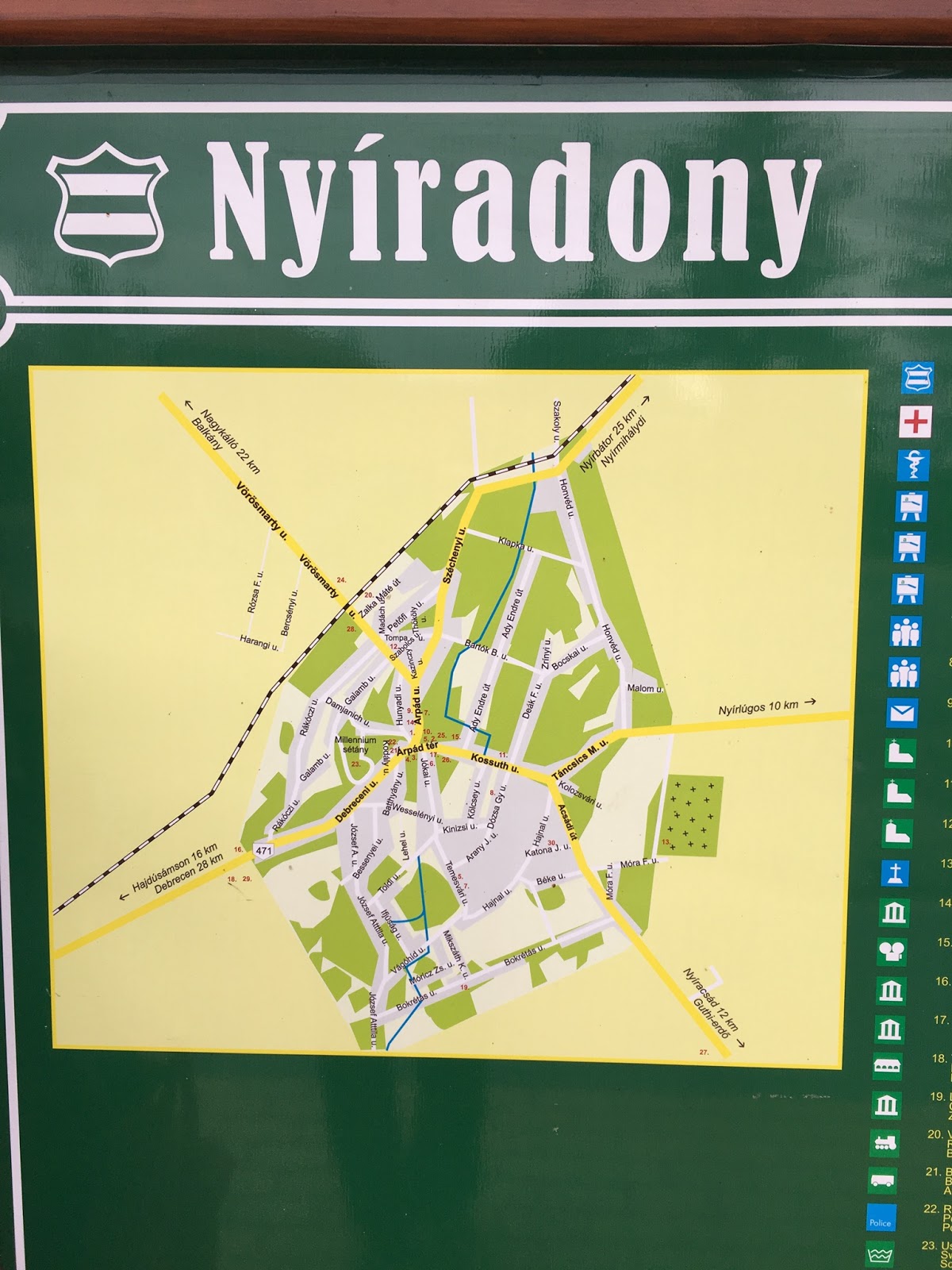
We parked and toured the village on foot.  We found a village map that included a brief history in Hungarian, German and English.  We tried, unsuccessfully,  to find local cemetery and after purchasing some Paprika and some pastries we returned to Debrecen.
Marilyn at the Nyiradony sign

Marilyn looks for clues at the church

Town map of Nyiradony

Marilyn and Carl read the history of Nyiradony

The village crest

After coffee and pastries in the Villa Hotel lobby, and a rest, we took the tram to downtown Debrecen for a self-guided walking tour.  The largest church is the Great Reformed Church found by Protestants in the 17th century.  The downtown buildings are a mixture of Baroque styling and Soviet plain architecture.  The pink town hall is an odd combination of styles.
Great Reformed Church

Beautiful mosaic of town crest

Lobby of hotel on the town square

Debrecen City Hall

Carl helps a tree that had drooped in the park

Austrian influences in buildings

Outside the Deri Museum

Returning to the Hotel we used the last remaining daylight to walk in the park before having a Hungarian dinner at the Leveles Csarda restaurant beside the hotel.  We were the only people in the restaurant!
Marilyn and Carl skip like school kids

The beautiful park reflected in the pond

Carl and Marilyn strike a pose above the waterfall

Dwight poses next to the giant leaf sculpture

Day 17: Timisoara Romania and Debrecen Hungary

Since Romania is one hour ahead of Hungary and central Europe, we decided to meet our hosts Mihai and Lydia at 10:00AM in the lobby.  After introductions, we set out for a walking tour of downtown Timisoara.  Timisoara has a history that dates back to the Turks in the 16th century.  When the Austrians drove out the Turks in the 17th century they built stone bastions to defend the city.  Lydia showed us one of the remaining parts that has been converted into a artist studios and restaurants.
Lydia shows the group the city walls made by the Turks

Arches inside the city wall stored supplies and weapons

Plaques above the shop doors show city bastions

A monument shows how the bastions looked before the Austrians drove out the Turks

Next, we visited Union Square which has been renovated.  This square shows the diversity in Timisoara's history.  On opposite sides of the square are a Serbian Orthodox and Catholic Church.
Union square

Fountain in Union Square

Art showing Eve and the Serpent

Mihai and Lydia explain the square that held the Turkish baths

Square with Cathedral

Local dancers perform in front of Cathedral

Carl admiring his graffiti just before his arrest

After a late breakfast at a cafe, we continued touring the recently renovated areas.  In the last two years the city has banned cars in the renovated sections and restaurants and shops have sprung up like mushrooms.

To see the rest of this city of 300,000 people we rode the circle line tram.  The neighbourhoods are a blend of new and old, dingy and renovated.  As architects, Mihai and Lydia will have plenty of work as the renovations continue over the next decade.  

The newly completed Business Center complex discovered water control dams built by the Austrians when digging the foundations.  The architects incorporated the lumber and stones into an exhibit in the courtyard.
Explanation of Austrian waterworks at Business Center

Original brickwork of Austrian water controls

Timisoara Business Center

For lunch, Mihai generously hosted us at a new Italian Bistro and toasted our health with a round of Tuica, a local liquor made from plums.  It was strong but smooth.  After lunch, we toured the university and the square outside the Metropolitan cathedral.  
Italian Cafe where we enjoyed lunch

Dwight's salad and empty Tuica glasses

When it began to rain, we decided to depart.  After thanking Mihai and Lydia for their generosity with some Ice Wine and inviting them to come to Canada, the travelling group left in our separate ways.  Richard, Cheryl and Warren set off for Budapest for their flight home the next day and Marilyn, Carl and Dwight set off for Debrecen.

Both groups had a long drive reaching their destinations after dark.  Rick and Cheryl's GPS failed them but Cheryls' map reading skills saved them, and their headlights needed to be pointed to be effective.  Our drive went through eastern Hungary along many isolated small roads.  Carls' calm driving skills and Dwight's navigation got them to Debrecen safely.  The Villa Hotel in Debrecen changed their entrance since my GPS map was made so we had to drive across a tram track, through a park and into the parking lot after moving a bicycle rack!  It was shades of the Black Forest adventure again!

Wednesday, 5 October 2016

Day 16: Glogowatz & Timisoara Romania

After a hearty breakfast we set off for the Budapest Airport via a shuttle that cost the group 40 euros.  The driver told us about the Hungarian referendum the previous day on immigration.  The country voted 90% against the EU quota of 2000 Syrian refugees that Hungary must accept.  Unfortunately, less than half of the people voted.  Its hard to know the will of the people.  I guess Hungary's history of being invaded and occupied has made them wary of newcomers.

Arriving at the airport car rental counters we realized our rental were with Usave Hungary (Thrifty) not Europcar as Pedro told us.  USave's counter was off site so we had to call for a pickup.  No car rental counter would let us place the local call, nor even help us figure out how to use the pay phone!  Eventually, I used my cell phone to call for a pick up.  We were amazed at how unhelpful many of the Hungarians in the service industry were!

Once the car rentals were arranged we set off for the 3 hour drive to Glogowatz (which is now called Vladimirescu, Romania).  The Hungarian motorways are smooth and fast.  The speed limit is 130km/h!  We arrived at the Romanian border and had to go through customs.  After a 15 minute wait we  next had to purchase a Romian road toll pass from some unfriendly officials who preferred Euros to the Romanian currency.

The drive through Arad featured roads in bad shape, lots of industry and obvious poverty.  Since we arrived near 4:00 PM, the traffic was snarled for about 10 km.  Finally, we arrived at Glogowatz, parked and explored the town on foot.  We found a church that mentioned Glogowatz and the sign entering town had a blurb about Glogowatz: (Translation from Google Translate)

This village was inhabited mostly by ethnic Germans and was colonized in the years 1724-1756.  Out of respect for their livelihood, peace and goodwill are wished by the Romanians. It is reminded that until 1945 this town was called Glogowatz.
The group looks for Gologwatz clues at the church

A plaque on the statue outside the church

A plaque above the door to the church

Marilyn and Carl look for German names on monuments around the town,

A sign entering the town acknowledges the history of Glogowatz

The history in Romanian is translated above

We tried to find the railway station without success.  Also, a trip to the cemetery did not yield any tombstones from before world war II.  The Catholic cemetery was locked so we could not check it out either.

Since we were running out of daylight, we set out for the Continental Hotel in Timisoara.  The GPS failed us in the convoluted city streets of Timisoara but Google maps on my phone rescued us.  Rick and Cheryl with their built in GPS had better luck.  A tired group enjoyed a nice late dinner in the hotel dining room and turned in after a long day.
Interesting geometry of the central lobby in the Continental Hotel

We tried the local Ursus beer at dinner


Day 15: Budapest

It is time for the adventurous group to set out on own, and more importantly, to have to pay for our own food and drink!  After a final breakfast, we checked out of our cabins and had the Viking staff hold our bags until we check into the Roombach Hotel.  

We decided on two activities: a visit to the Gellert spa for Rick, Warren, Marilyn and me; and discovering the Buda side for Carl & Cheryl.  Waking across the Chain bridge we took the tram along the Buda shore.  Buying tickets was a challenge at the automated machine but we figured it out.  

The Gellert spa was built in the late 18th century into the hills near the river.  A thermal well was dug to access the hot mineral waters.  The bathing pavilion is built in Baroque style with frescoes on the ceilings and mosaic and tiled walls.  The change rooms are unisex and feature cabins for each person to change and store their valuables.  We soaked in pools that were 36C and 40C both indoors and outdoors.  We also tried the steam room and the 90C Finnish sauna.  By mid morning, pools were becoming crowded.  We left at 12:30 after 2 and half relaxing hours.  Carl and Cheryl climbed to the top of the Buda hill and visited the church carved into the hill.
Marilyn outside the Gellert Spa

Entrance to Gellert Hotel

Stained glass in lobby

Chapel in the Gellert hill

View of Gellert Hill from the bridge

Budapest market

On the way back to the ship we crossed the Elizabeth bridge to the Pest side and had lunch on Vaci Utica at a sidewalk cafe.  After a quick tram ride we retrieved our bags and left the Viking Legend for the nearby Roombach Hotel by taxi.  After checking in, Marilyn and I set off to the nearby Bubbles laundromat to get some clean clothes for the last week.  In the evening, we went to a local restaurant for an authentic Hungarian meal.  The dropping temperatures and rain brought our streak of good weather to an end.

Day 14: Cruise - Budapest, Hungary

After our late night entry to Budapest, we awoke to a morning tour of Budapest, followed by some exploration on our last day on the cruise.

On the guided tour we learned about the strategic location of Budapest in the middle of Eastern Europe at the cross roads of trade and its history of invaders and occupiers.  In the 13th century, the Mongols sacked the city twice.  In the 16th century,  the Ottoman Turks invaded and occupied Budapest for 150 years.  In the 17th century, the Austrians drove out the Turks and rebuilt Budapest in Baroque style.

Budapest is really two cities separated by the Danube river running north to south.  The older hillier side, Buda, is older since it has the castle.  St Matthias church is high on the hill in Trinity square.  It was build as a mosque by the Turks.  When converted to a Catholic church it retained the Islamic patterns and designs.  The views of the river and of the Pest side on the east are magnificent.  The Pest side is much younger as most of it was wiped out in a flood in 1838.  The Austrians required all new buildings to spend 30% of their budget on exterior design so the building are quite striking.  The Hungarians were part of the Austro-Hungarian empire but were heavily taxed to support the opulent buildings in Vienna.
St Mattias Church on Buda Hill

St Mattias Church

Parliment buildings from Buda Hill

The altar inside St Mattias church

Murals have an Islamic influence

Heroes square was built by Hungarians 1896 to commemorate the millennium of the Magyar migration from the steppes of central Asia.  The square has statutes of all the Hungarians kings and museums on both sides.
Monument to Hungarian Kings in Heroes Square

Museum next to Heroes Square

Monument to St Stephen in Heroes Square

After the tour and lunch on the ship we explored the Pest side on our own.  On the banks of the Danube are bronze shoes to remember the Jews who were shot by the Nazis on the bank leaving only their shoes before their bodies were dumped in the Danube.  We walked around the magnificent Parliment  buildings but could not get an English tour.  Across from the Parliment is a building that shows bullets in the wall from the 1956 Soviet put down of the Hungarian Spring.
Shoes on banks of Danube commemorating the Jews killed by Nazis

Square outside Parliment buildings
Warren and Richard see the bullet holes from 1956 Soviet put down of Hungarian Spring

Founatin and square in Budapest

Dwight and Carl admire statue of portly guard

St Stephen's Cathedral in Budapest

Can you see Marilyn, Cheryl and Warren?

Warren slakes his thirst

Sunset of the Chain Bridge from the Legend sun deck

Carl was impressed with his "four fingers" of Jameson whiskey

We walked back to the ship through parks and the square beside St Stephens Cathedral.  After our final dinner on the ship was a Hungarian song and dance show in the lounge.  A marvelous way to end our Viking cruise.